

Green Aeration, Surfactant
Green aeration, surfactant
Aerate the green, hydrate the soil.
Green aeration, breathing air into your greens.

It's the same reason farmers till their fields. It's to break up the hard soil so that water can permeate better and provide more oxygen to the roots. Oxygen is a more important element to soil and grass than water. Grass shares it with people.
Because plowing greens and fairways requires the course to be closed for longer periods of time, we utilize a less disruptive method: aeration.
Aeration is usually done two to three times a year. It is also common to drill very small holes in the greens, which is a ventilation operation during the season, to remove moisture from the greens, help them dry out, and replace gases and oxygen that are prevalent in the grass as needed.
Another purpose is to remove organic matter. As the grass grows over the season, it dies and leaves behind a decomposing substance called thatch. If this is not removed through aeration, the organic matter will suffocate the grass.
There are several types of aeration, including coring, which involves digging holes, solid tines, which involve drilling thin holes, water injection, and 'slicing & spiking', which involves cutting off the roots and drilling holes. All of these operations help to aerate the soil, loosen the soil, remove organic matter, and encourage better root growth.
Recovery varies with climate. Aeration in early fall recovers very quickly because night temperatures do not drop much. Spring and late fall have shorter days, lower temperatures, and frost at night, so recovery takes longer.
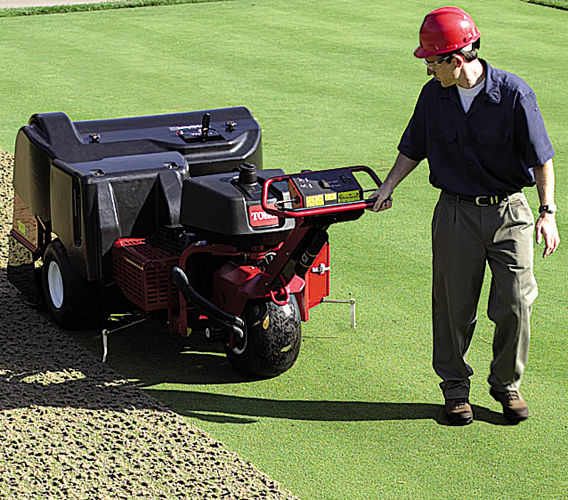


Aeration work

This is because the soil, which has hardened due to continuous farming from late fall last year to early spring this year, needs to be broken up. The grass roots that are just beginning to grow actively need to be revitalized.
When the soil hardens due to compaction, the roots have difficulty breathing due to lack of oxygen in the soil, and water and nutrients also have difficulty penetrating, which naturally weakens the grass. Therefore, it is necessary to drill into the soil and fill it with good sand so that oxygen, nutrients, and water can be smoothly supplied to the roots. In this way, after aeration, healthy roots will grow, grow deep, and properly absorb nutrients. Naturally, the grass density will increase, which will also improve the visual quality. Therefore, this work must be done in April, which is the optimal time for work.
Composition of the work team - usually 4 teams
1. Team that pierces the green surface with an aerator,
2. A team that uses a machine like a vacuum cleaner (sweeper) to suck up the grass core that has risen to the surface while drilling through the green.
3. A team that applies sand to the green surface using a sand trowel and continuously supplies sand from the storage area.
4. Divide into teams to do the final finishing touches by dragging the mat and filling the holes with sand sprinkled on the green surface.
Once the last team has holed out on the first hole green, the sequential work begins as the team in charge of the first aerator moves to the first hole.


에어레이션 장비운용
Aeration of golf courses is an essential task that greatly contributes to the long-term health of turfgrass by reducing thatch and organic matter, releasing soil compaction to increase soil oxygen, and stimulating root growth.
In order to create a soil environment where grass can grow well, you can choose various equipment and work methods depending on the conditions and situations of the work area. The types of aeration can be categorized and applied by long or short tines, perforated or non-perforated tines, vertical or swing-type aeration, cutting with a rotating blade or cutting deeply with weight, etc. Let's look at the pros and cons of each work method. (Editor)
■Long Tine vs Short Tine
They come in a variety of lengths, from 1 inch (2.54 cm) to 16.75 inches (42.54 cm).
Generally, the deeper the aeration, the longer the grass roots tend to be, so it is better to work as deep as conditions allow, but you should consider the type of equipment, the depth of underground facilities (such as dams and sprinklers), and the bedrock when making your selection.
Longer grass roots allow for longer watering intervals, fertilizers last longer and increase soil oxygen levels.
When performing high-intensity renewal work using deep, coarse tine, it is also possible to improve the green sand composition without resting the soil.
Early aerators came with tines attached to rollers, but modern aerators have tines attached to a crankshaft, which allows for more airflow at higher speeds while reducing turf damage.
■Vertical vs. Swing
If you divide aeration into the movements of others, there are vertical and swing methods, and these days, there is also dual-purpose equipment.
The vertical method is advantageous when the grass has poor resilience as it creates clean holes in the grass with less damage.
The swing method shakes the soil while making holes, and relieves the pressure between holes. However, it should be used with caution when the grass has weak resilience. By adjusting the amount of swing, the amount of lifting of the grass surface can be increased from almost nothing to about 2 cm.
Relief of soil compaction provides the necessary oxygen supply, increasing the overall cation exchange capacity and improving soil drainage.
■Mu-gong-ta-in vs. Yu-gong-ta-in
Depending on the type of equipment, the choice of others is also important.
In the case of vertical work machines, careful selection is required as using a non-porous tamping device may result in increased pressure.
When using a vertical tine, it is possible to use very thin tine to work on hydrophobic greens, minimizing turf stress and improving rapid aeration and drainage. However, if this method is used too often, it can increase the pressure and cause bigger problems.
Therefore, it is generally recommended to use a method of extracting cores and carrying out soil removal using a perforated tine for vertical equipment.
The swing method mainly uses a non-porous tine. The main purpose is to relieve the pressure, and if a perforated tine is used, the tine will bend or break and become unusable. If you perform a swing motion with a non-porous tine, you can relieve the pressure in the process of shaking the soil and create microscopic cracks, which greatly improves the ventilation.
Neither of the two tines is recommended for use on soils that are completely dry. Working in a dry condition will cause the tines to heat up due to friction, which can damage the grass, and the equipment will be subjected to a lot of stress, increasing the risk of breakdown.
■ Vertical Linear Aeration (VLA) vs. Tines Aeration
Another device that can be considered for pressure relief is Vertical Linear Aeration (VLA). This device has similar pressure relief capabilities to deep-swing aeration, except that it uses blades instead of tines.
The blades, which are about 25cm to 38cm long, move forward as if cutting the soil. Powered by the tractor PTO, the blades attached to the shaft rotate. The blades are attached in an alternating manner, and as they sequentially penetrate the ground, they shake the soil left and right in a wave shape, thereby relieving the pressure.
It does not remove soil from the ground, but it relieves a significant amount of compaction. The area cracked by the VLA equipment may dry out, so it is necessary to water frequently as after other aeration operations until recovery.
In soils with the same conditions, the VLA method can usually work deeper than the tine aeration method. The equipment structure is also simple, so maintenance costs are also low.
Suitable for situations where the pressure is severe and the use of the tine aerator is not smooth. There is also an optional sand hopper that can be installed to add sand to the cut section to improve drainage.
■Rolling Slicer
Another form of aeration, this is a very simple structure. The purpose is to cut rather than relieve pressure. It is advantageous for cutting grass with a prostrate stem, such as Korean grass or Bermuda grass. Cutting the prostrate stem helps the grass grow upward.
The same effect can be achieved with VLA equipment. Since the pressure relief is not very effective, additional pressure relief measures must be provided.
There are also machines that add a pressure relief feature by giving the blade an angle. They are less expensive, but cause additional damage to the grass, so be prepared for the recovery time.
■Vibrational tines without holes
It is too strong to be used on greens, but can be used on fairways, rough, and sports fields. It is excellent for relieving pressure on the surface of about 10 to 15 cm.
Using a mower will not remove any grass at all, and you can also use it with an additional seeder.
■Preventive work vs. curative work
If you are wondering how often you should do deep aeration, you should first know that the purpose of deep aeration is to prevent compaction rather than relieve compaction.
It is also good to deeply drill the greens in spring and fall and perform thin-tine aeration in summer. For warm-season grass fairways, there is also a method of performing deep aeration in summer. It may be a matter of budget, but by providing sufficient aeration at the right time, you can reduce the use of pesticides and water, and you can purchase an aerator with the maintenance cost.
■Water injector and sand injector
Water injectors are used to inject high-pressure water into the ground, which can be used when the grass becomes hydrophobic due to summer stress. You just need to be prepared to replenish the water, and you can play right after the operation.
Sand injection machines work on the same principle as water injection machines. When water is injected, the siphon effect injects the materials contained in the hopper. Soil conditioners and seeds for sowing can also be injected.
■Drill and Fill
This equipment has been in use since the 1980s. It is useful when soil improvement is needed. It is sufficient to work at the depth of a deep aerator.
There is almost no shaking on the grass surface, so it is not suitable for relieving pressure. It is slow at about 1/4 the speed of other deep aerators, and labor costs are high because the hopper needs to be continuously filled. However, there is almost no change in the surface after operation, so it has the advantage of being able to play right away.
■Micro tines micro tines
This is a technique mainly used on greens. It can quickly ventilate the area under the green surface by piercing the turf layer with a very thin, non-porous or perforated tine of about 0.6 cm.
Micro tines do not relieve pressure and are mainly intended to penetrate the erosion layer, and are only about 2.54 cm to 4 cm long. For maximum ventilation, it is recommended that the gap between holes not exceed 8 cm.
Even if the core is extracted, the amount is small and can be blown out with a blower or put in a green mower bucket, and recovery is quick, taking place within a day or two. Since it does not extract sand, it does not cause the bed knife to become dull after the operation.
Green pressure does not occur overnight, and it is rare for pressure to be completely relieved with one operation. Careful observation and selection of appropriate operation timing will allow you to find the most ideal operation cycle.